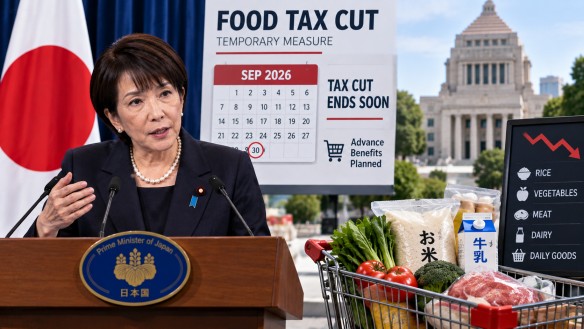
The Japanese government is gearing up to offer advance cash payments to low- and middle-income households to cushion the effect of a reinstated food consumption tax rate. This initiative is set to follow the expiration of a temporary tax reduction, which will lower the consumption tax on food from 8% to 1% for two years beginning in April 2027. Once this reduced rate ends in April 2029, eligible households will receive half of their annual benefit upfront to mitigate the financial burden as the tax reverts to 8%.
Starting in April 2027, the income-based benefit program will distribute payments that vary depending on the recipients’ income levels and the number of children in their households. It is projected that the annual payouts for fiscal years 2027 and 2028 will total approximately ¥600 billion, equivalent to $4 billion. The Japanese government is aiming to finalize this policy by September and intends to present the necessary legislation during an extraordinary parliamentary session anticipated in October.
To finance this tax reduction, the government plans to reevaluate current subsidies, special tax measures, and overall government spending, thus avoiding the issuance of deficit-financing bonds. However, the exact sources of funding have yet to be confirmed. Meanwhile, additional measures are being planned to support sectors such as agriculture, forestry, fisheries, and restaurant businesses that might be impacted by the tax changes.
Retailers will also be given extra time to adapt to the requirements for tax-inclusive price displays, ensuring compliance with the new regulations without causing undue disruption. This comprehensive approach reflects the government’s commitment to mitigating the impact of changing tax rates on both consumers and businesses.